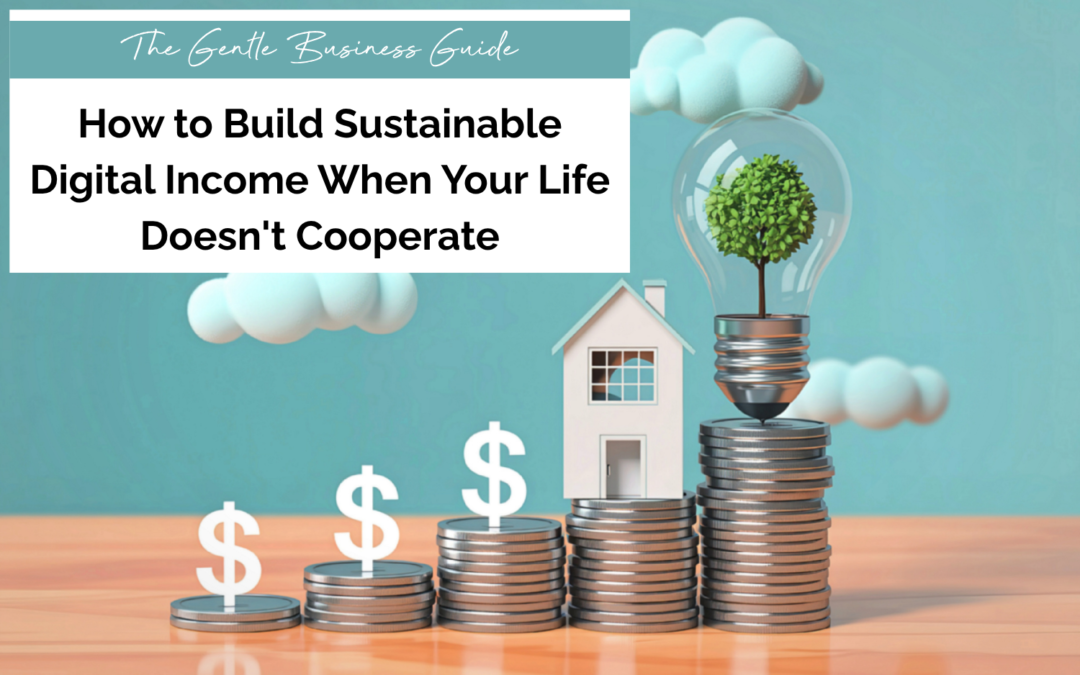
Everything you need to know about creating a digital product business that works around chronic illness, caregiving, unpredictable days, and an economy that makes financial stability feel increasingly out of reach.
There is a version of online business success that gets talked about constantly — the six-figure launches, the passive income dashboards, the entrepreneur who built a course empire from her laptop while travelling the world. It’s aspirational content, and for a specific kind of person in a specific kind of situation, it might even be accurate.
But there is another version of this story that rarely gets told. The woman who built something real and meaningful while managing a body that doesn’t cooperate on demand. The mother whose business had to survive school crises, meltdowns, medical appointments, and the particular exhaustion of caring for a child with complex needs. The person whose anxiety or chronic pain or PTSD means that “just show up consistently” has never been straightforward advice — and whose business had to be designed around that reality rather than in spite of it.
This post is for that woman.
It is also, practically speaking, a map. Over the past several months I’ve written five detailed posts addressing the specific obstacles that sit between women like us and a business that actually functions — the courses that failed us, the social media pressure that exhausts us, the AI tools we’re not sure how to use without losing our voice, the scheduling systems that assume a life we don’t have, and the economic uncertainty that makes all of it feel more urgent. This post draws those threads together, with links to the deeper dives where they’re relevant.
If you’re new here, this is the best place to start. If you’ve read some of those posts already, this gives you the full picture in one place.
The Problem With Most Online Business Advice
Before getting into what works, it’s worth being direct about what doesn’t — and why.
Most online business content is written by people who built their businesses without the constraints that define daily life for a significant proportion of women. They had health. They had time that was mostly their own. They had the ability to show up consistently, to launch on schedule, to respond to a bad month by simply working harder. Their advice is built on those foundations, and it reflects them — whether or not it acknowledges doing so.
The result is a vast body of business guidance that is technically accurate for the circumstances in which it was developed, and structurally incompatible with a different set of circumstances. Time-blocking doesn’t work when someone else controls your time. Daily posting doesn’t work when your body can’t guarantee a good day. High-ticket service income doesn’t work when your capacity to serve clients is unpredictable. Launch-based revenue doesn’t work when a crisis can land in the middle of any given week without warning.
None of this is a personal failing. It is a mismatch between the advice and the life — and recognising that mismatch is the starting point for building something that actually works.
The five areas below represent the most significant obstacles I’ve seen women in this situation face, and the clearest paths through them.
1. The Courses That Failed You Were Not Designed for Your Life
If you have bought online business courses and never finished them, you are in extraordinarily common company. The completion rates for online courses across the industry are low — often below 10% — and the reasons are rarely about motivation or discipline. They are about design.
Most online business courses are structured for people with predictable time, consistent energy, and the ability to maintain momentum across weeks and months. They are long — sometimes exhaustingly so — because length signals value in a market where buyers judge comprehensiveness before they’ve experienced usefulness. They build on themselves sequentially, which means missing a module creates a sense of falling behind that, for many people, becomes a reason to stop entirely.
For women managing health challenges or caregiving responsibilities, these structural features aren’t inconvenient — they’re disqualifying. And when the course doesn’t get finished, the failure rarely gets attributed to the course. It gets attributed to the person. She concludes she’s not disciplined enough, not committed enough, not the kind of person who follows through.
That conclusion is wrong, and it does real damage — not just to confidence, but to the willingness to try again when a genuinely different approach becomes available.
A course designed for interrupted lives looks different in specific ways: it is completable in fragments without losing coherence, short enough that the end is always visible, built around survival before aspiration, and explicit about what to do when everything falls apart. The presence or absence of these features is worth examining before investing in anything new.
Read the full post: You Didn’t Fail the Course. The Course Failed You.
2. You Don’t Need Social Media to Build a Real Business
The idea that social media presence is mandatory for online business success is so pervasive that it functions less like advice and more like received wisdom — something people repeat without examining whether it applies to their particular situation.
It doesn’t apply to everyone. And for women whose health, nervous system, or daily circumstances make consistent social media presence genuinely unsustainable, treating it as mandatory doesn’t just create extra work. It creates a permanent sense of falling short — of being one viral post away from the business finally working, while the real obstacle goes unnamed.
Email is a more durable foundation for a digital product business than social media for several reasons that are worth understanding clearly. Your email list is an asset you own outright — no algorithm can reduce your reach overnight, no platform can be acquired or regulated out of existence taking your audience with it. Email converts to sales at a consistently higher rate than social media because the people on your list have made an active choice to hear from you. And email allows the kind of depth — story, argument, nuance, genuine relationship — that the format constraints of social platforms make difficult or impossible.
An email-based sales system has four components that each do a specific job: a lead magnet that solves a real problem and earns the subscriber’s trust before asking anything of them; a welcome sequence that establishes who you are and what you believe, running automatically from the moment someone joins; a regular email — fortnightly is enough — that delivers genuine value on a rhythm your life can sustain; and a soft sales sequence that leads naturally from the value you’ve been providing to an invitation to go deeper, without the jarring gear-change of a hard sell.
The question of how to grow a list without social media has practical answers: search-optimised content, guest appearances on podcasts and in others’ newsletters, word of mouth from buyers who got results, and paid traffic when the time and budget are right. None of these require daily visibility or public performance.
Read the full post: How to Sell Digital Products Without Social Media
3. AI Can Help You Build Faster — If You Use It Correctly
The flood of AI-generated content that arrived in the online business space from 2023 onwards created a legitimate problem: it made the internet louder, cheaper, and harder to trust. Niches that were already crowded became saturated with content that was technically competent and completely interchangeable — the average of everything that came before, assembled quickly and published without any genuine perspective behind it.
Understanding this problem is important, because it clarifies both what to avoid and what the actual opportunity looks like.
AI search tools — Perplexity, ChatGPT Browse, Google’s AI Overviews — are actively calibrated to deprioritise content that lacks genuine experience, expertise, and perspective. The E-E-A-T framework (Experience, Expertise, Authoritativeness, Trustworthiness) that guides quality evaluation across these systems means that lazy AI content doesn’t just fail to build trust with human readers — it underperforms in the algorithms that determine who finds your content in the first place.
The opportunity, then, is not to avoid AI but to use it differently than most people do. The distinction that matters is between thinking work and production work. Thinking work — the angle you take, the story you tell, the opinion you hold, the specific experience you draw on — is irreplaceable and has to remain yours. Production work — structuring an outline, drafting sections you’ll rewrite, generating options to react to — is where AI saves real time and reduces the production burden that makes content creation feel impossible on difficult days.
For women building on limited capacity, this distinction is practically significant. AI used correctly makes it possible to produce content that genuinely represents you on days when generating from a blank page would have been out of reach. The content still has to be yours — your voice, your stories, your specific knowledge — but AI handles enough of the structural and drafting work that the barrier to actually finishing something is meaningfully lower.
Read the full post: How to Use AI in Your Online Business Without Becoming Part of the Noise
4. The Problem Isn’t Your Discipline — It’s the Wrong Kind of System
Conventional productivity advice rests on an assumption it never states: that your days are basically yours to organise, and that consistency is achievable if you want it badly enough. For women managing unpredictable health, caring for others, or living with the cognitive and emotional weight of anxiety or PTSD, this assumption fails before the advice attached to it has any chance of working.
The result is a familiar cycle: build a system, maintain it until something disrupts it, abandon it when it becomes impossible to maintain, feel guilty about the abandonment, rebuild a new system, repeat. The problem gets attributed to the person — her discipline, her follow-through, her commitment. The actual problem, which is that the system was built for a life she doesn’t have, goes unexamined.
Two reframes change this significantly in practice.
The first is the Enough List: replacing an open-ended to-do list with a maximum of three tasks that would make the week feel like genuine progress. Not everything you should do — just the three things that, if completed and nothing else, would mean the week moved your business forward in a real way. Three tasks completed fully generates more momentum than ten tasks half-done, closes the open loops that create ambient anxiety, and — critically — is survivable when the week falls apart, which it will.
The second is replacing routines with rhythms. A routine is fixed in time and brittle under pressure. A rhythm has a shape and a frequency but not a rigid schedule — it says I write once a week, whenever this week allows, not I write every Tuesday at 9am. Rhythms create forward motion without demanding the kind of consistency that an unpredictable life can rarely guarantee. The women who tell me they can’t stick to anything have almost always been trying to maintain routines. When they switch to rhythms, the experience changes completely.
5. Why This Business Model Is Built for Economic Uncertainty
There is a particular kind of vulnerability that economic downturns create for women who were already working with thin margins on time, energy, and income. Part-time and flexible work arrangements — disproportionately held by women managing health or caring responsibilities — are typically the first to contract when budgets tighten. Service income that depends on client discretionary spending evaporates faster than income that doesn’t. And the conventional response to income loss — work harder, take on more, expand into new markets — runs directly into the capacity constraints that defined the situation before the downturn began.
Digital products, structured correctly, offer a different relationship with economic volatility. They are not immune to it — nothing is — but they have structural features that make them more resilient than most alternatives available to women in this situation.
The key features are worth naming precisely. Products at accessible price points continue to sell when higher-priced alternatives get cut from budgets. Products built around evergreen problems — how to build income around limited capacity, how to manage overwhelm, how to create stability when conventional options aren’t available — become more relevant during difficult times, not less. And an income stream decoupled from your working hours — one where the assets you built continue functioning whether or not you’re present — doesn’t collapse when a crisis takes you offline for a week or a month.
This last point is worth dwelling on, because it represents the structural argument for this model that gets made least often and matters most. The goal of automation and systems in a gentle business isn’t passive income in the aspirational sense. It’s a floor — a baseline of function that the business maintains when life requires your full attention elsewhere. Not explosive growth on autopilot, but stability that holds when you can’t.
The honest caveat is that building to this point takes time — typically months of front-loaded work before the income becomes meaningful. Digital products are not a solution to an immediate financial crisis. They are a medium-to-long-term strategy for building income that is more durable than the alternatives, and that was always the right frame for them.
How These Five Things Work Together
Read separately, each of these posts addresses a distinct problem. Read together, they describe something more coherent — a specific approach to building a business that starts from the reality of a constrained life rather than trying to fit that life into a framework built for someone else.
The through-line is this: every conventional piece of online business advice has a hidden assumption about the person following it. Uncover the assumption, and you can assess whether the advice applies to you. When it doesn’t — when the assumption is wrong for your life — the solution isn’t to try harder to meet the assumption. It’s to find an approach that starts from where you actually are.
That means building products, not just services, so your income isn’t entirely dependent on your hours. It means using email as a primary channel, so your business doesn’t live or die by an algorithm you can’t control. It means using AI to reduce the production burden without outsourcing the thinking that makes your work worth finding. It means working in rhythms and managing by sufficiency — the Enough List — rather than chasing a consistency that your life can’t reliably provide. And it means building for durability rather than speed, because a business that survives your worst weeks is more valuable than one that thrives only in your best ones.
Where to Start
If you’re new to this and feeling the gap between where you are and where you want to be, the most useful thing I can offer is not a roadmap. It’s a question.
What would your business look like if it was designed honestly for the life you actually have — not the life you’re hoping to have once things settle down, but the current one, with its interruptions and constraints and unpredictable days?
Most business advice asks you to adapt yourself to a method. The approach I’ve spent sixteen years developing asks the method to adapt to you. That reversal sounds small, and its practical implications are significant.
The Life Panel Quiz (free here) is the best starting point if you want to understand which area of your business foundation needs the most attention right now. It takes about five minutes and gives you a specific place to focus rather than a general sense that everything needs work.
The Hallway Method is the fuller framework — a structured path from wherever you are now to a digital product business that functions within your actual capacity, with the systems and automation built in from the start rather than bolted on later.