

Let me say the quiet part out loud: no one in history has ever planned their week and had it go exactly as they envisioned. Not one person. Not ever.
So why bother planning at all?
Here’s the thing. The people who do plan ahead? They are so much better at pivoting when the unexpected happens — and trust me, with kids, a job, and the general chaos of being a functioning adult in the world, the unexpected always happens. They get the most important things done with fewer late nights and less resentment. They end the day feeling like they actually moved forward instead of just surviving.
And here’s what will either thrill you or blow your mind a little: a 2024 study found that just 10–12 minutes of morning planning can recover nearly 2 hours of lost time and boost your productivity by 25%. Despite that, 82% of people still work without any kind of formal planning routine.
You read that right. Ten minutes in, two hours back. That is the best ROI I’ve ever heard of, and I’ve been in the nonprofit sector where we squeeze every last drop out of every resource.
So today I want to make the case — and then give you the actual tools — for why a small daily planning habit is one of the most valuable things you can do for your work life. Especially if you’re also managing school pickups, dinner, and whatever your kids decided to dramatically melt down about this week.
Your Brain Is Not a Task Management System
Here’s a key principle I come back to over and over: your mind is a great place to have ideas, but a terrible place to manage them.
The research backs this up pretty bluntly. Our brains can only reliably track about 7 items at once before errors start creeping in. Seven. And that limitation affects everyone — surgeons, software engineers, and yes, busy parents juggling a full-time job and a family.
When you’re walking around with a head full of “stuff” — the email you need to send, the permission slip, the thing your manager mentioned on Friday, the birthday gift you haven’t ordered yet — your brain is working overtime just to hold all of that. That’s mental energy that isn’t going toward actually doing the work.
Here’s another thing that might sting a little: multitasking isn’t actually possible. What we call multitasking is just rapid context-switching, and studies show it tanks your productivity by 40%. Every time you jump between tasks, your brain pays a tax. Close the extra tabs. Flip your phone face down. Work on one thing at a time. I promise it helps.
The goal of planning isn’t to create a perfect schedule. It’s to get things out of your head and into a system you trust, so your brain can do what it’s actually good at: thinking.
Planning Is Productive Friction
I’ve started thinking about planning as productive friction — that intentional pause that actually speeds you up in the long run.
Here’s the deal: when you take 5–10 minutes to actually think through your day (not just react to whatever’s screaming loudest), you’re creating forced thoughtfulness. It’s that moment where you ask yourself, “What actually matters today?” instead of diving headfirst into your inbox.
Yes, it feels counterintuitive to slow down when there’s so much to do. But those few minutes of planning are what make the difference between being busy and being effective. You’re essentially making a promise to yourself — spend a little time up front to ensure the next 8 hours move you in the right direction, not just in circles.
It’s the difference between wandering through a forest hoping to find your way out versus taking a moment to check your compass first. (For the record, I have an extraordinarily bad sense of direction, so I feel this metaphor deeply.)
Here’s something I hear a lot: “But Jess, where am I even going to find the time to plan?” And I get it. Truly. When your plate is already overflowing, adding one more thing feels absurd.
So let me say this clearly: yes, there is theoretically a point at which you could spend too much time planning. Some people do get lost in the system instead of doing the work — color-coding their planner for three hours instead of, you know, working. That’s a real thing.
But if you are not yet spending 20 minutes planning your week, or 5 minutes to plan your day before diving right in? You are nowhere near that point. Not even close. The risk for most of us isn’t that we’re over-planning — it’s that we’re not planning at all, and then wondering why we feel scattered and behind all the time. The 10 minutes you’re “too busy” to spend planning is costing you the 2 hours you keep wishing you had.
Here’s a 2-minute video on how I plan my day: Watch here (it’s even got a little love for alliteration, which is one of the tiny joys I enjoy every day).
Okay, But How Do I Actually Do This?
Glad you asked. Here are four practical things you can start doing right now.
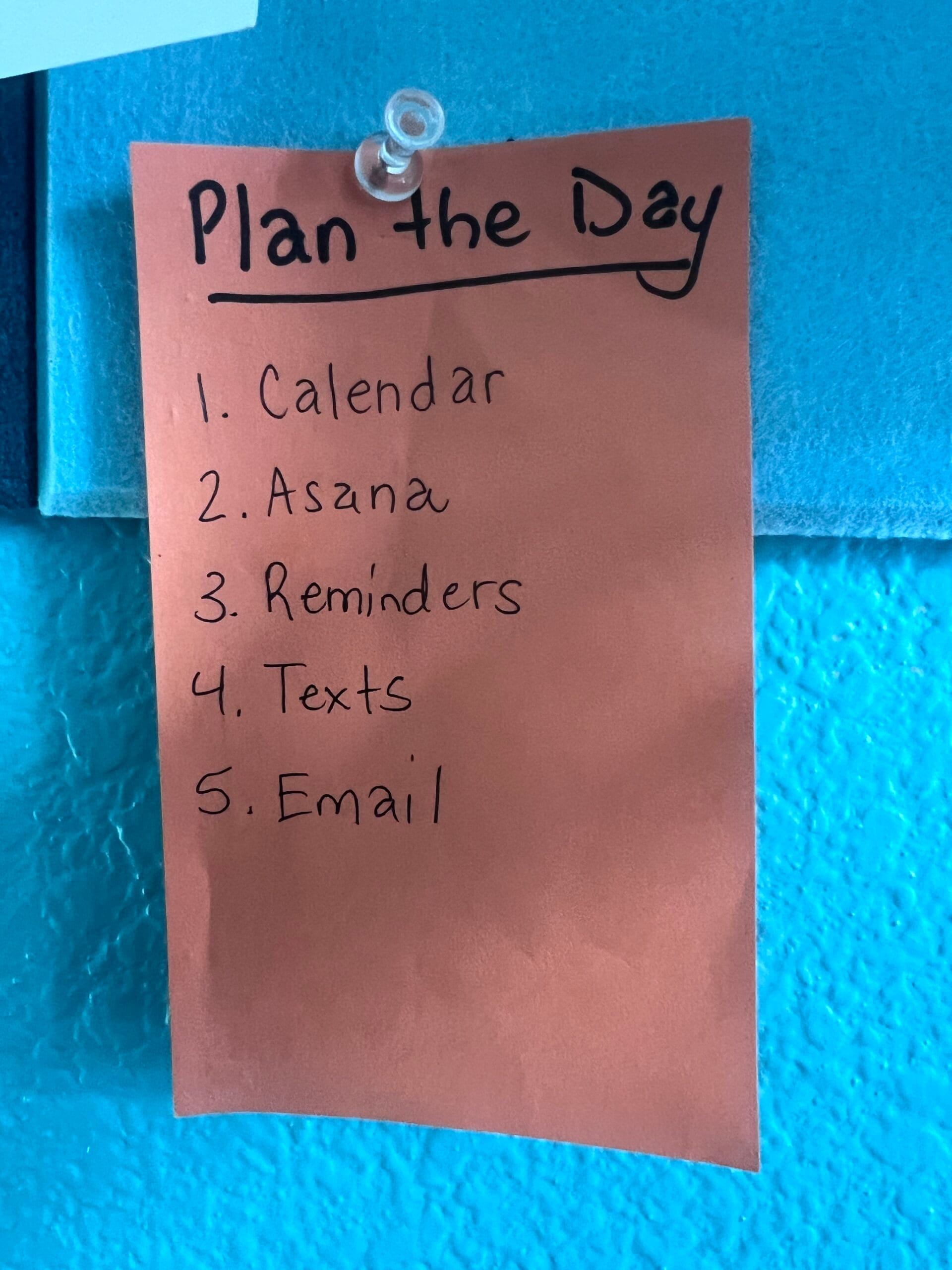
1. Make a “Start the Work Day” Checklist
If you’ve been in my world for very long, you know I love a good checklist. The research supports how they create mental ease and help us avoid errors — and I’m a big believer in using them to set yourself up right at the start of the day.
Try this: write a checklist (even just on a sticky note) of 3–5 things you do to start your workday, or where you need to look to ensure you’ve captured everything. Some of these might be about setting priorities — “review and star priority emails,” “pull must-do tasks from Asana,” “check reminders app.” Others might be about managing your energy properly — “get a glass of water,” “decide when to go on a walk and mark it on my calendar,” “set alarms so I don’t miss meetings.”
Don’t make it too long. Just your key startup tasks. I promise you’ll feel more together. Here’s a post-it I use that helps me make sure I check all the key places in my own world.
2. Plan Your Week in 3 Steps (Takes Less Time Than You Think)
Once a week — I do mine Friday afternoon, some people prefer Monday morning or Sunday — take 20–30 minutes to actually look at the week ahead. Here’s my approach:
Step 1: Gather your tasks. Your to-dos are probably scattered everywhere — Asana, handwritten notes, email, Slack, your reminders app, your brain. Round them all up into one place. A list of 50 things to do is so much better than a vague sense of I am swamped and behind on everything.
Step 2: Organize them your way. By priority? By day? By project? There’s no one right answer — the best system is the one you’ll actually use. Some people love a color-coded weekly planner, others use a simple Meetings/Must/Maybe structure on a notepad. Figure out what feels right for your brain.
Step 3: Create a daily list. Because plans change, and a full week of tasks is too much to look at on any given day. Each morning, narrow it down: What are my meetings today? What absolutely must get done? What would be nice if I got to it?
3. When You’re Feeling Scattered, Do This
We all have those days — or honestly, weeks — where it’s coming at you from all directions and you don’t even know where to start. Here’s the best thing I know to do:
Get everything into one place. All of it. Even if that list has dozens (or hundreds) of items on it, that’s better than a vague sense of overwhelm.
Then — and this is my favorite part — imagine your favorite colleagues and friends standing next to you, looking at your list. What would they tell you needs to come off? Where are you doing too much? In what areas are you holding yourself to an unnecessarily high standard?
Take their imaginary advice and push those things. You’re allowed to do that.
4. Build a Weekly Planning Habit That Sticks
Two things help make weekly planning a consistent habit:
Block it on your calendar. Protect that time like it’s a meeting with your most important stakeholder. (Because it is — that stakeholder is you.)
Consider habit stacking. Could your weekly planning happen right after something that’s already a strong habit? Right after your Friday lunch? Right after the kids go to bed Sunday? Attaching a new habit to an existing one makes it much more likely to stick.
Also: know in advance which parts of your planning are absolutely essential versus nice-to-have. That way, when things get crazy (and they will), you can do the essentials in 10 minutes and still get the benefit — without sacrificing your whole system just because life happened.
You’re Not Behind. You’re Just Learning a Skill
Here’s something I want to say directly to you: being organized is morally neutral. It’s okay that this is hard. It’s hard for most of us.
If you’re feeling any kind of shame like, “I shouldn’t need to work on this, I should already just know how to do this” — I want you to acknowledge that feeling and then let it go. Working parents have more on their plates than almost any generation before us. You’re not failing. You’re investing in your own effectiveness, your own wellness, your own calm, and your own joy.
That’s worth ten minutes a day.
Get Started Right Now
Want to put this into practice? Grab free resources that will help at jessicaeastmanstewart.com/
You’ve got this. I really believe that.